

Air ducts are commonly considered for professional cleaning every 3 to 5 years, but there is no fixed cleaning schedule that applies to every home. The U.S. Environmental Protection Agency (EPA) recommends cleaning residential air ducts only when needed, based on their actual condition. Homes with excessive dust buildup, pest contamination, or confirmed mold problems may require attention sooner.
Your home's air ducts carry heated and cooled air between the HVAC equipment and individual rooms. Over time, dust, pet hair, and other particles can accumulate inside these passages. However, some dust accumulation is normal and does not automatically indicate that professional cleaning is necessary.
The frequency of air duct cleaning depends on household activities, filter maintenance, environmental conditions, and the amount of contamination present. Understanding these factors can help homeowners avoid unnecessary cleaning while recognizing problems that deserve professional attention.
How Often Should You Schedule Professional Air Duct Cleaning?
Many residential cleaning guides suggest evaluating air ducts for cleaning every 3 to 5 years. The National Air Duct Cleaners Association (NADCA) has also suggested cleaning intervals of approximately 4 to 5 years in earlier homeowner guidance, depending on household conditions.
However, the EPA does not recommend routine cleaning at a fixed interval. Its guidance emphasizes inspecting ducts and cleaning them when specific problems are present.
| Household Condition | Recommended Approach |
|---|---|
| Well-maintained home with no visible contamination | Inspect periodically and clean when needed |
| Home with multiple shedding pets | Inspect more frequently |
| Household with indoor smoking | Monitor for increased residue |
| Recently renovated home | Inspect for construction debris |
| Visible debris coming from supply vents | Arrange professional inspection |
| Suspected mold inside ductwork | Investigate and correct moisture problems |
| Rodent or insect infestation | Address pests and evaluate cleaning or replacement |
| Water-damaged insulated ductwork | Evaluate affected material for replacement |
These recommendations are based on conditions rather than guaranteed cleaning intervals. A properly maintained system may not need cleaning simply because several years have passed.
What Are the Signs That Air Ducts Need Cleaning?
An inspection can help determine whether contamination has reached a level that justifies professional cleaning. Dust on the outside of a return grille is common and can usually be removed during household cleaning.
More significant warning signs include:
- Excessive dust or debris visible inside the duct passages.
- Particles being discharged from supply registers.
- Evidence of rodents or insects inside the ductwork.
- Substantial visible mold growth on hard duct surfaces.
- Construction debris left inside the system after renovation.
- Heavy accumulations that obstruct airflow.
- Persistent contamination originating from HVAC components.
The EPA recommends considering duct cleaning when these kinds of conditions are confirmed. A contractor should be able to show evidence of the contamination rather than recommend cleaning based only on the system's age.
Do Homes With Pets Need More Frequent Duct Cleaning?
Homes with shedding pets may accumulate additional hair and dander around return grilles and filters. The amount entering the ducts depends on the filtration system, how well the filter fits, and household cleaning habits.
Having pets does not automatically mean the ducts need annual cleaning. Instead, homeowners should inspect accessible areas and check for significant deposits. Keeping return grilles clean and maintaining suitable HVAC filters can help limit buildup. When pet hair accumulates heavily inside the duct network, professional cleaning may be appropriate. The decision should follow visible conditions rather than pet ownership alone.
Should You Clean Air Ducts After Home Renovation?
Renovation projects can generate substantial drywall dust, sawdust, and construction debris. Some of this material may enter HVAC ducts if registers remain uncovered or the system operates during construction.
After renovations, inspect the accessible supply and return passages. If significant debris has entered the system, professional cleaning may be appropriate before continued normal operation. Future contamination can be reduced by protecting duct openings during construction and following suitable HVAC shutdown procedures. A contractor should inspect affected components before recommending cleaning.
How Often Should You Clean Air Ducts if You Have Allergies?
Homeowners with allergies often consider duct cleaning to reduce indoor particle exposure. However, the EPA states that research has not conclusively demonstrated that routine residential air duct cleaning prevents health problems or consistently reduces indoor airborne dust.
Allergens can originate from bedding, carpets, pets, outdoor air, and many other sources. Cleaning ducts alone may not address these exposures. People experiencing persistent symptoms should discuss them with a qualified healthcare professional. HVAC filter maintenance, moisture control, and appropriate household cleaning remain useful parts of indoor environmental management. Duct cleaning is more clearly justified when inspection identifies substantial contamination that needs removal.
Does Mold Mean Your Air Ducts Need Cleaning?
Substantial visible mold growth inside hard-surface ducts warrants professional evaluation. However, material that resembles mold cannot always be identified reliably by appearance alone.
The source of moisture must be found and corrected before cleaning. Otherwise, contamination may return. The EPA advises that wet or moldy fiberglass duct insulation cannot be effectively cleaned and should be removed and replaced. This distinction matters because cleaning damaged porous insulation is not the same as cleaning sound sheet metal. Avoid purchasing automatic antimicrobial spraying services without understanding the product, application, and need for treatment.
How Can You Keep Air Ducts Cleaner for Longer?
Preventing contamination is often more useful than scheduling cleaning at arbitrary intervals. Dust enters HVAC systems through return airflow, poorly fitted filters, and unintended openings.
Useful maintenance practices include:
- Inspecting HVAC filters regularly and replacing them according to manufacturer guidance.
- Vacuuming return and supply grille surfaces.
- Keeping construction dust away from duct openings.
- Repairing significant duct leaks.
- Correcting plumbing leaks and condensation problems.
- Maintaining cooling coils and condensate drainage.
- Addressing pest entry points.
These practices reduce opportunities for contamination to accumulate. They do not eliminate all household dust, but they help maintain the duct system between inspections.
What Happens During Professional Air Duct Cleaning?
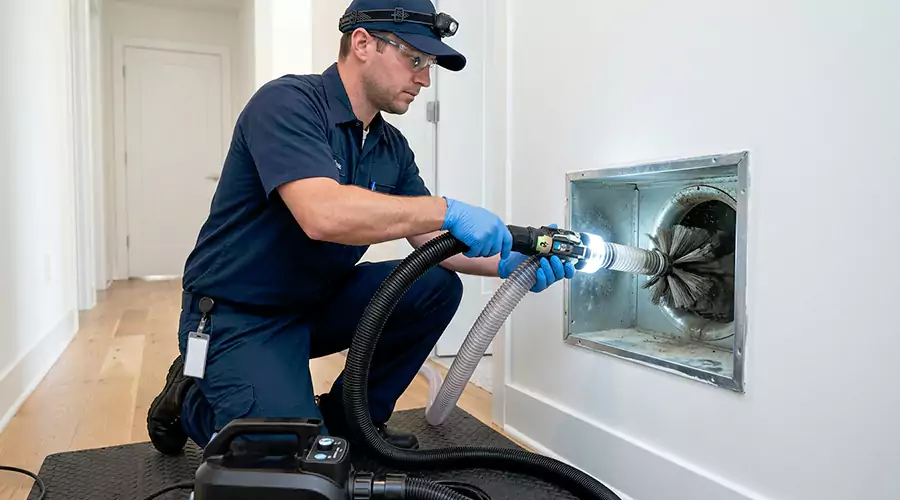
Professional cleaning typically begins with inspecting the HVAC system and identifying affected components. Technicians then use specialized equipment to loosen and collect dust and debris.
NADCA describes source removal as the foundation of proper cleaning. The process uses agitation tools together with negative-pressure vacuum collection to capture loosened material instead of releasing it into occupied rooms. Depending on the agreed scope, technicians may clean supply and return ducts, registers, plenums, and accessible HVAC components. The cleaning methods must be compatible with the duct materials. The contractor should inspect the system afterward and properly close any temporary access openings.
How Much Does Air Duct Cleaning Cost?
According to Angi's October 2026 pricing data, professional residential air duct cleaning typically costs approximately $271 to $509, with an average around $389. Larger systems and more extensive cleaning scopes can cost more.
Pricing depends on home size, vent count, duct accessibility, and contamination levels. Companies may charge by system, vent count, or project. Ask for a written estimate describing the complete service. A very low advertised price may exclude important components or lead to unexpected additional charges.
Is Annual Air Duct Cleaning Necessary?
Most residential systems do not require professional duct cleaning every year. Annual HVAC maintenance and periodic inspection are different from annual duct cleaning.
Homeowners should have the HVAC equipment maintained according to its manufacturer's schedule. This may include filter changes, coil inspection, and condensate maintenance. Duct cleaning should be recommended when an inspection identifies conditions that justify the work. A company claiming that every home needs annual duct cleaning should be asked to explain the specific reason.
Conclusion
Air ducts are often evaluated for cleaning every 3 to 5 years, but their actual condition matters more than the calendar. The EPA recommends cleaning when significant contamination or other documented problems make it necessary. Pets, renovations, moisture, and pest activity may justify closer inspection. Routine filter maintenance and moisture prevention can help reduce future buildup. Before scheduling professional air duct cleaning, inspect the system and ask the contractor to explain why cleaning is needed.